Part 1
Peru remains one of the most promising landscapes in specialty coffee.
Discovering the Depth of Peruvian Coffee
I first started roasting and buying coffee in 2018, at a time when my understanding of great coffee was shaped by the usual powerhouses: Colombia, Ethiopia, Guatemala, and Kenya. Peru, on the other hand, barely registered on my radar. As a roaster, I saw Peruvian coffee as little more than a “blender” component—a budget-friendly filler for our darker roasts, valued more for its price than its flavors. It was simply more affordable than Guatemalan or Colombian options, and that was its primary role.
That perception changed when I received a set of samples from an up-and-coming exporter determined to showcase Peruvian coffee to the wider world. As I cupped through the lineup, I was caught off guard. These coffees had clarity, complexity, and vibrant fruit notes that demanded attention. Frankly, they outshined many of the Colombian coffees I had been tasting at the time.
That moment sent me down a path I hadn’t expected: a personal quest to uncover the truth about Peruvian coffee. What made these coffees so good? Why had they been overlooked for so long? And how had a country with such clear potential remained in the shadows of the specialty coffee world?
This is the story of that journey.
Going to the Source
In 2021, I traveled from Fort Wayne, Indiana, to Jaén, Peru, driven by a single question: What makes Peruvian coffee so special, and why doesn’t the world know about it yet?
The best way to answer this was simple—taste as many coffees as I could and visit as many farms as possible. So, I made an ambitious request to our exporting partners: Show me everything.
They took me seriously. Upon arriving at the lab in Jaén, I was greeted with over 50 coffee samples waiting for me. “Knock yourself out,” they said, half-joking. I gulped three huge glasses of water, steadied myself, and started cupping.
The coffees were organized in two ways: by profile or by region. One table held all sun-dried natural coffees, another showcased washed coffees from a specific neighborhood where most farmers shared similar tree varieties and processing techniques. This setup allowed me to compare without distraction—each coffee had its own identity, a unique fingerprint of the land and the farmer’s skill.
The next day, I went through another 50 samples. On the third day, I revisited the standouts, focusing on the most expressive and distinct profiles.
What immediately struck me was the sheer diversity of Peruvian coffee. Even among farmers from the same neighborhood, their coffees could taste completely different. One might have deep, rich notes of blackcurrant and star anise, while their neighbor’s coffee burst with bright lemon acidity and floral complexity.
I kept asking myself: Why don’t more roasters know about this?
Transparency Obscured
Transparency is a buzzword in the coffee industry, but in Peru, its absence has long shaped the lives of coffee farmers.
Roasters and buyers want to know where their coffee comes from—who produced it, what varieties they grow, how altitude and climate shape its flavor. But transparency goes beyond traceability; it’s about accountability and fairness. It means knowing not just where coffee is grown, but how it moves through the supply chain:
- What was the farmer actually paid?
- What were the costs of moving the coffee from farm to mill to exporter?
- How much value did processing add?
- What margin did intermediaries take?
For farmers, transparency means power. It means knowing the true worth of their coffee, understanding its quality, and having access to buyers who will pay a fair price. Without it, farmers are left to sell blindly into a system that offers no recognition or reward for excellence.
The exporter I was traveling with explained that Peruvian coffee had long been seen as a “cheap” option—much like many Brazilian coffees, primarily used as a filler to keep blends competitively priced. Because of this, most farmers—whether producing exceptional or mediocre coffee—had their harvests bulked into large regional or cooperative lots, stripping away any chance to stand out.
This system didn’t just homogenize quality—it suppressed value. Farmers had no idea how good their coffee actually was. Even worse, intermediaries who did understand the quality often hid that knowledge, keeping prices artificially low while pocketing the margins.
Without transparency, Peruvian farmers weren’t just underpaid; they were disempowered. They had no way to advocate for themselves, no clear path to improve their earnings, and no direct access to buyers who might truly value their work.
But that was beginning to change.
The exporter I was traveling with had a clear mission: to break that cycle. Their goal was to create single-farmer microlots that highlighted the skill of Peru’s best producers while also developing community-driven blends that captured the unique flavors of specific regions. More than that, they wanted to bring honesty and integrity to the Peruvian coffee trade—ensuring that farmers understood their quality, had access to financial and agricultural training, and could build relationships directly with roasters.
Each time I tasted a coffee that stood out, I’d ask about the farmer behind it. Without hesitation, the exporter would tell me their story—whether they were just beginning to enter higher-value markets, refining their craft, or had already mastered the art of producing world-class coffee.
It was clear: knowledge was the difference between barely scraping by and building something lasting.
The Farms, Firsthand
After three days of cupping, I was ready to step beyond the lab and into the fields.
The first farm visit took us deep into a remote community, tucked between towering mountains and surrounded by thick forest. This region, despite producing some of the most striking coffees I had tasted, was almost entirely cut off from the rest of the country. A single, winding dirt road provided the only access, but even that came to an abrupt end well before reaching the farms. From there, we had no choice but to continue on foot, trekking for two hours through dense, humid terrain.
At one point, we lost the trail and had to navigate a river, slipping on moss-covered rocks as we crossed. The air buzzed with the relentless hum of mosquitoes, and my arms and legs quickly became a patchwork of scratches from thorn-covered plants. When we finally arrived, exhausted and dripping with sweat, I took in the scene before me—lush green hills covered in coffee trees, their branches heavy with fruit, stretching as far as the eye could see. It was stunning, but the reality of farming here was anything but romantic.
The Logistics of Growing Coffee
If my two-hour hike to the farm had been grueling, I couldn’t imagine what it was like for farmers who had to carry hundreds of pounds of coffee cherries down these same trails after each harvest. The physical labor alone was staggering, but the journey didn’t end there. Once they reached the road, the coffee still needed to be transported to town, where the purchasing station was located. For many, this was a two-day ordeal—farmers would deliver their coffee, spend the night in town, and return home the next day.
Because of this, farmers in this area could only afford to deliver their coffee three times per harvest, meaning coffee often sat for weeks in humid conditions, prematurely aging before it even reached the mill. This had an inevitable impact on quality, yet there was little they could do to change the situation.
Labor Shortages and the Cost of Progress
As we walked among the farms, my colleague pointed out another major issue—labor shortages.
“No one wants to travel this far to work,” he explained, gesturing to the steep hillsides lined with coffee trees. “So farmers can’t collect all of their coffee. They actively lose income without enough pickers.”
I scanned the trees and saw the evidence firsthand—ripe, underripe, and overripe cherries all clustered together, some already shriveling into raisins. Without enough hands to pick at peak ripeness, much of the coffee was left to rot on the branch or was harvested too late, ultimately lowering its value.
Making matters worse, the trees were overgrown and planted too densely, creating a tangled, impenetrable layer that only added to the difficulty of picking. The solution was clear—farmers needed to cut down some of their trees, allow others to regrow, and restructure their farms for better productivity.
But the cost of that change was staggering.
“If you make $5,000 a year, barely enough to survive, what would you do if someone told you to cut down half your trees, halving your income for the next few years?” my colleague asked.
I knew exactly what I’d do. I’d keep every tree standing and hope for the best.
For farmers here, the choice was between short-term survival and long-term success—a choice that shouldn’t have to exist. Until infrastructure improved and more buyers recognized the value of these coffees, the economic reality remained harsh.
Yet, despite these obstacles, the coffee itself was exceptional.
A Different Story in a More Accessible Region
The next region we visited told a different story. This area was much closer to a major road, making it far easier to bring in labor and transport coffee to buyers. Instead of trekking through the jungle, we drove directly onto a farm, stepping out of the truck to be greeted by a young woman who was in the middle of renovating her entire farm.
“We’ve cut down nearly a third of our trees,” she explained, leading us through neat rows of freshly planted coffee trees. “We’re replacing them with Bourbon Amarillo and Gesha.”
Her decision made perfect sense. Just days earlier, I had cupped a Cup of Excellence-winning Gesha from this very region, and buyers were lining up to purchase from the farm that produced it. The potential here was undeniable, and unlike the farmers we had visited in the remote mountains, these producers had a clearer path to better pricing and international recognition.
Our guide explained how this neighborhood had only recently begun to see real success.
“Farmers here used to sell their coffee for the lowest prices on the market. They barely dried it, fermentation times were short, and there was little financial incentive to improve quality. But now, everything has changed. Every single buyer who visits us asks to see these farms. It’s even become competitive among buyers—everyone wants the best coffees from here.”
I would soon see just how true that was. Several of my colleagues—other coffee buyers I was friends with—were scheduled to visit this same area immediately after my trip, all eager to taste and purchase from these farms.
We followed a narrow path through multiple properties until we reached the farm that had produced the stunning Gesha I’d tasted earlier in the week.
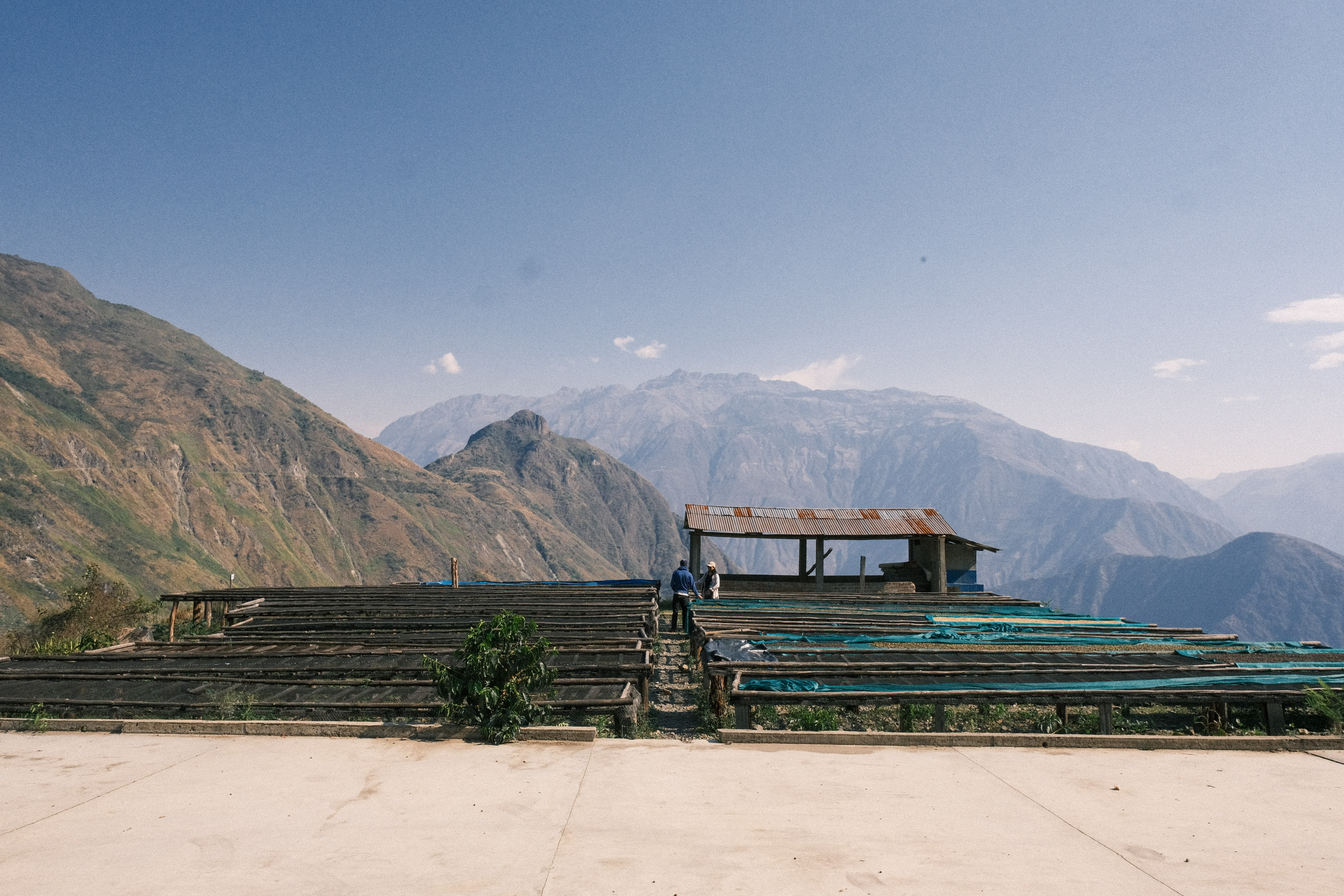
There, the farmer sat cross-legged in front of a small raised drying bed, layered with coffee. As we approached, I watched as he carefully inspected every single seed, meticulously picking out any defective or misshapen ones. I had never seen such diligence and care in coffee production before.
As we spoke, he told us how growing and selling Gesha had changed his life. Like most farmers in the area, he had never made much money from coffee—until he began cultivating high-quality microlots and selling them through an exporter who ensured his name was attached to the coffee. Now, buyers from around the world were coming to Peru just to meet him, to purchase his coffee, to showcase his work.
He had become a local legend, living proof that there was money to be made in coffee—if the right systems were in place.
Reflections and the Future
As I left, I couldn’t stop thinking about the stark contrast between these two regions.
In the mountains, farmers were producing outstanding coffee despite unforgiving logistics, labor shortages, and limited access to market knowledge. In the more accessible region, producers had begun to see the benefits of direct trade, premium pricing, and international recognition.
The difference wasn’t in the quality of the coffee—it was in the opportunities available to farmers.
Peru’s potential is undeniable. The flavors are world-class. The dedication of its producers is unmatched. But until infrastructure improves, until buyers recognize what’s possible here, and until farmers have true transparency in their pricing and opportunities, many will remain trapped in a cycle that limits their success. Earning an extra $1,200 a year for producing an 86-point coffee is a step forward—but it’s not enough. Roads need to be built. Labor access must improve. Structural change is required to unlock the full potential of Peruvian coffee.
Because Peru isn’t just another coffee origin. It’s a country producing some of the best coffees in the world, grown by farmers who deserve to be recognized and rewarded.
It’s time for the world to wake up to what’s happening in Peru.
Sharing Peruvian Coffee with the World
On my flight back to the U.S., my mind was racing.
I thought about the coffees I had tasted, the farmers I had met, and the stark differences between those with market access and those without. I thought about the producers hauling bags of coffee down mountain trails, about the drying beds filled with meticulously sorted Gesha, about the conversations where farmers lit up at the realization that their coffee was something special—that people across the world would want to drink it.
I felt like I had stumbled upon a hidden secret in coffee. A secret that shouldn’t be a secret at all.
Peru had everything—yet most of the world had no idea.
As soon as I returned to the office, I placed an order for several of the lots I had cupped during my visit. A few months later, those coffees arrived. I was eager to taste them again, but as I cupped through the samples, I felt something I hadn’t expected.
Some of the vibrancy and depth I had fallen in love with in Peru seemed muted. The coffees were still good—beautiful, even—but not quite as alive as I remembered them.
At first, I was frustrated. How could something that had been so expressive at origin lose its character in just a few months? Was it transport? Storage? Processing? Had I been caught up in the magic of the moment when I first tasted them?
I wasn’t about to let that be the final story. I dug into the roast, adjusting profiles, coaxing out the qualities I knew were in there. After my first round of production roasts, I breathed a sigh of relief—there it was. The essential characteristics that had captivated me in Peru were still there, just waiting to be unlocked.
But I knew that cupping in my own lab wasn’t enough.
I needed to share these coffees with people who could experience them the way I had experienced them—not just as another origin on a menu, but as something undeniable.
Bringing Peru to the SCA Expo
Not long after, I attended my first-ever SCA Expo in Boston, the biggest specialty coffee event in the industry.
I packed my bag to the brim with roasted samples, all from Peru. Not just to showcase my own work, but to showcase their work—the farmers who had spent decades growing coffee that had been overlooked for too long.
At various booths, I brewed cup after cup, pouring hundreds of small paper cups of coffee for passersby. I wasn’t trying to sell anything. I wasn’t there to promote a brand. I was simply hoping someone would stop, take a sip, and realize what I had realized in Peru.
And to my surprise, they did.
People stopped mid-step, turned around, and backtracked to the booth, eyebrows raised, eyes wide.
“Where is this coffee from?” they asked, incredulous.
“Peru.”
“No way. It has to be from Panama. Or Colombia. Or Ethiopia.”
“Nope. Just Peru!”
“It must be Gesha.”
“No, just a traditional Bourbon.”
“What about the fermentation?”
“Classic washed. I saw it myself.”
I watched as people took another sip, shook their heads, and started asking real questions.
“Why don’t we hear more about Peruvian coffee?
Who are the farmers behind these lots?
How do we get more coffee like this?“
For the first time, I wasn’t just advocating for Peruvian coffee, I was seeing people wake up to what had been in front of them all along.
This wasn’t just another coffee origin. Peru wasn’t just a “blender” coffee.
Without a doubt, Peru is producing some of the best coffee in the world.

Leave a Reply